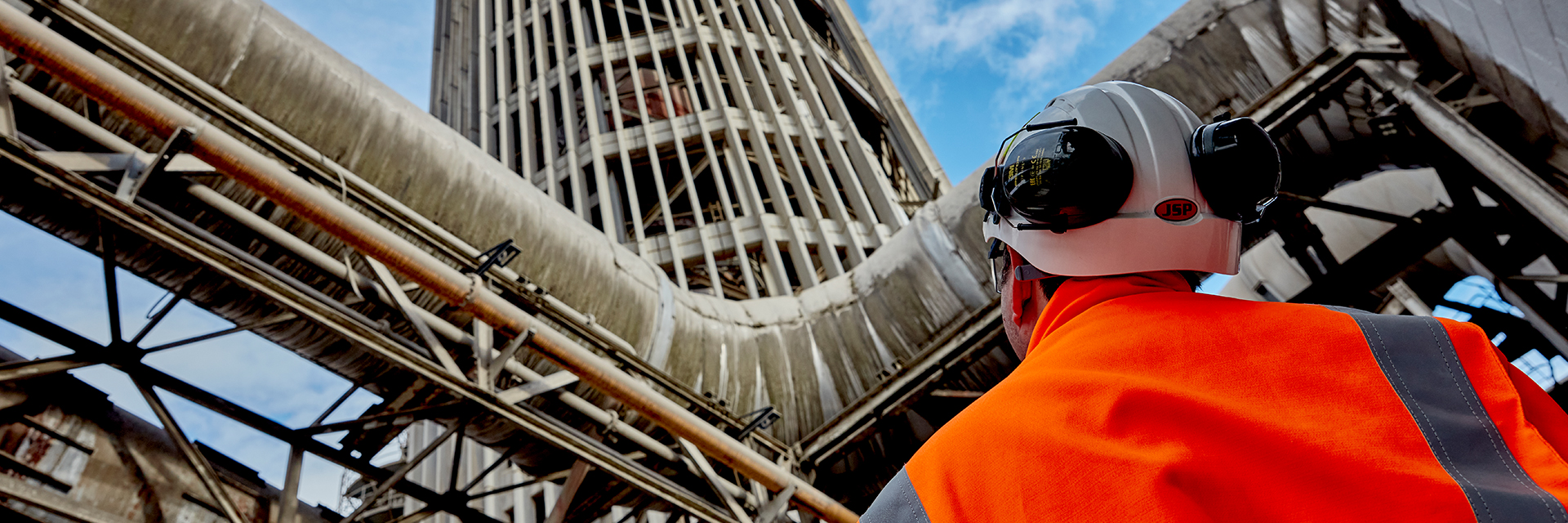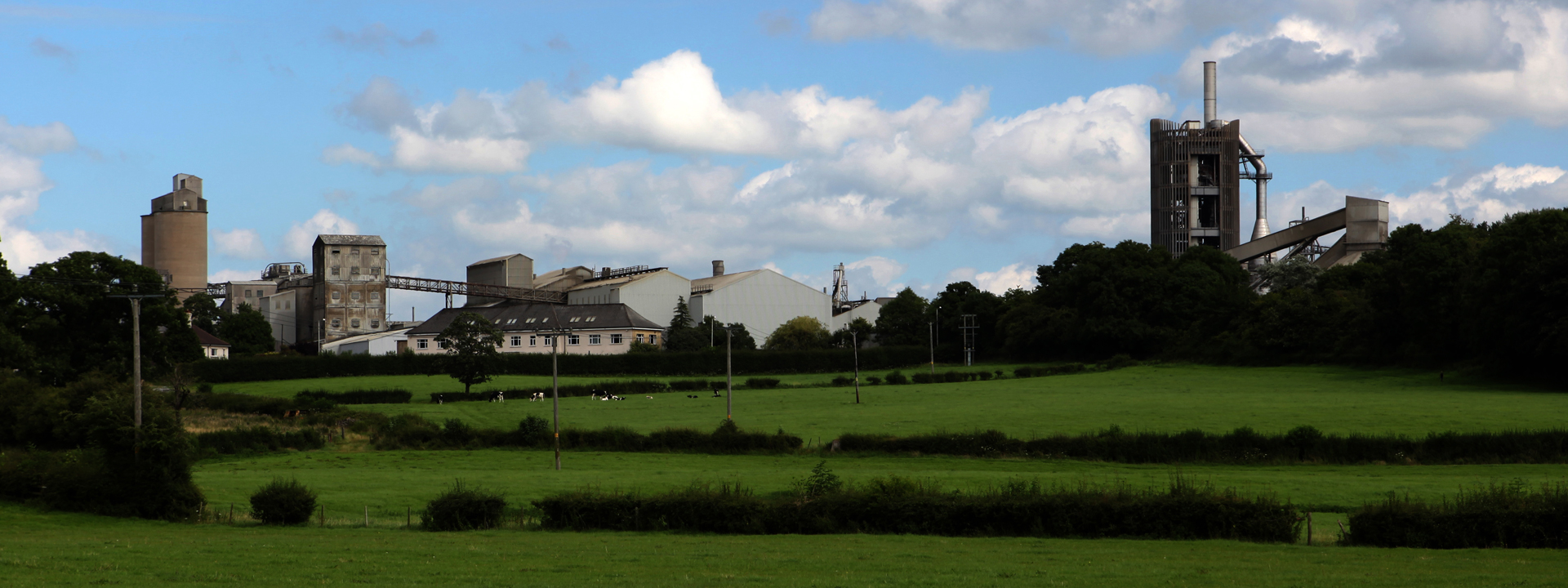
Situated in the beautiful Ribble Valley on the edge of Clitheroe, our Ribblesdale cement works was first built on its current site in 1936 as a joint venture between Tunnel Cement and Ketton Portland Cement. Two years later, following investment in additional wet kilns, the works was producing 750,000 tonnes of cement a year. The biggest increase in production capacity came in 1983 when £30 million was invested in a new dry‑process kiln, enabling 1.3 million tonnes of cement to be produced each year. At one time, the works was the largest clinker producer in the UK and has produced well over 50 million tonnes of cement.
Production from the older wet‑process kilns ceased in 2005 and all clinker production was focused on the single remaining, much more efficient, dry‑process kiln. In recent years, improvements have been made to the dust filters, resulting in a reduction in emissions. In 1998, Ribblesdale became the first cement works in the UK to install a gas cleaning system (also known as a wet scrubber) attached to the dry‑process kiln. This reduces the amount of sulphur dioxide produced by 90 per cent and halves the already small amount of dust and ammonia produced, making the kiln one of the cleanest in existence. The gas scrubber was upgraded in 2018 at a cost of around £9 million.
In 2021 we successfully operated our cement kiln at Ribblesdale using a net zero fuel mix as part of a world‑first demonstration using hydrogen technology. Ribblesdale thus became the first cement works in the world to use hydrogen as part of a net zero fuel mix to operate one of the kilns. The trial showed how we can potentially move away from using fossil fuels in cement and concrete production and could help us meet our decarbonisation goals.
The limestone and clay needed for cement production at Ribblesdale are supplied by two on‑site quarries – Lanehead and Bellman – where quarrying first took place in Ribblesdale 400 years ago. These quarries have been screened by thousands of trees and screening banks to shield the view from neighbouring properties. They provide rich, diverse habitats including woodland, grassland and water bodies, which are home to species such as badgers, bats, nesting peregrine falcons and amphibians. We also provide facilities on site to the Ribble Rivers Trust, a charitable organisation working to improve, protect and promote the River Ribble, which passes along the boundary of our works, for both people and wildlife. The raw materials used in the cement works are 340 million years old.
Products, uses and reach
The cement powder produced at Ribblesdale is supplied in bulk and in bags and is used across the UK to make ready‑mixed concrete, precast concrete products, grout, mortar and other cement‑based products that help build homes, schools, hospitals and critical infrastructure such as flood defences, roads, bridges and tunnels.
Ribblesdale cement works supplies cement to distribution depots as far apart as Glasgow, Middlesbrough and Bristol. It has supported projects as diverse as Liverpool’s Roman Catholic Cathedral, the Skye Bridge, major on‑shore and off‑shore wind farms, Renaker Towers in Manchester and Hinkley Point C nuclear power station, currently the largest building project in Europe.
Learn more about how cement is made
People, economy and community
The site employs over 200 people in both production and distribution roles, from blasting and extraction of materials from our two quarries to packing and distribution of the finished product. This is supported by a highly technical maintenance team and a dedicated process and quality control function, with many more companies and individuals involved in the wider supply chain. The site contributes more than £11 million to the local economy every year.
We are committed to being a responsible operator and recognise our responsibilities as a major industry in the Ribble Valley and Lancashire as a whole. We actively support local initiatives and programmes which benefit the community and environment, helping to ensure that our long industrial history in Ribblesdale—stretching back over 400 years of quarrying—continues to make a positive material difference.
Contact us
For all enquiries, please email the Plant Manager at gary.young1@heidelbergmaterials.com
Become a supplier
Request information about how to become a supplier.
Request a community visit
We welcome school and college visits to our site, host community open days and carry out a broad range of regular community support initiatives.
Request a donation
Assistance is prioritised to groups making applications from those based within a five-mile radius of the Ribblesdale site. To make an application for funding, material donation and/or volunteer support, please tell us about your group and/or project, what type of support you are seeking and how your project’s aims dovetail with our support initiative goals.
Grange Top quarry becomes site of major palaeontological find
Remains of the world’s first pterosaur from the Middle Jurassic period have been uncovered at our Grange Top quarry in Rutland, which is adjacent to our Ketton cement works.
Academic study confirms success of Ribblesdale world-first hydrogen fuel trial
The results of an academic research study have confirmed the success of the net zero fuel trial carried out at our Ribblesdale cement works in Clitheroe.
Another carbon capture breakthrough demonstrated
We have demonstrated another ground-breaking carbon capture process, this time at our Ribblesdale cement works in Clitheroe, Lancashire.
World first net zero fuel trial success at Ribblesdale
A cement kiln at our Ribblesdale works in Lancashire has successfully been operated using a net zero fuel as part of a world first demonstration using hydrogen technology.
Liaison group
The Ribblesdale liaison group meets every six months to share information on the site’s operations, including on especially with regard to environmental performance.
Attendees are nominated from neighbouring parish councils, Ribble Valley Borough Council (RVBC) and Lancashire County Council (LCC), as well as LCC planning and the Environment Agency.
The meeting is an opportunity for local community representatives to discuss all aspects of the operation, including quarrying activities.
The standard agenda for the meeting is:
- Plant operational report
- Production
- Environmental monitoring
- Emissions/monitoring/complaints etc
- Key projects update
- Plant improvements/investment program
- 2030 sustainability targets
- Quarry and biodiversity update
- Any other business
Careers at Ribblesdale
At Heidelberg Materials in the UK, you’ll be part of One Team across around 300 manufacturing sites, with career opportunities in diverse roles from production and operations to sales, IT, engineering and finance.
We also offer a range of apprenticeships, a higher-apprenticeship programme for school leavers, and a structured graduate scheme in disciplines such as engineering, geology, marketing and STEM, enabling you to earn, learn and build a long-term career in the mineral products industry.