

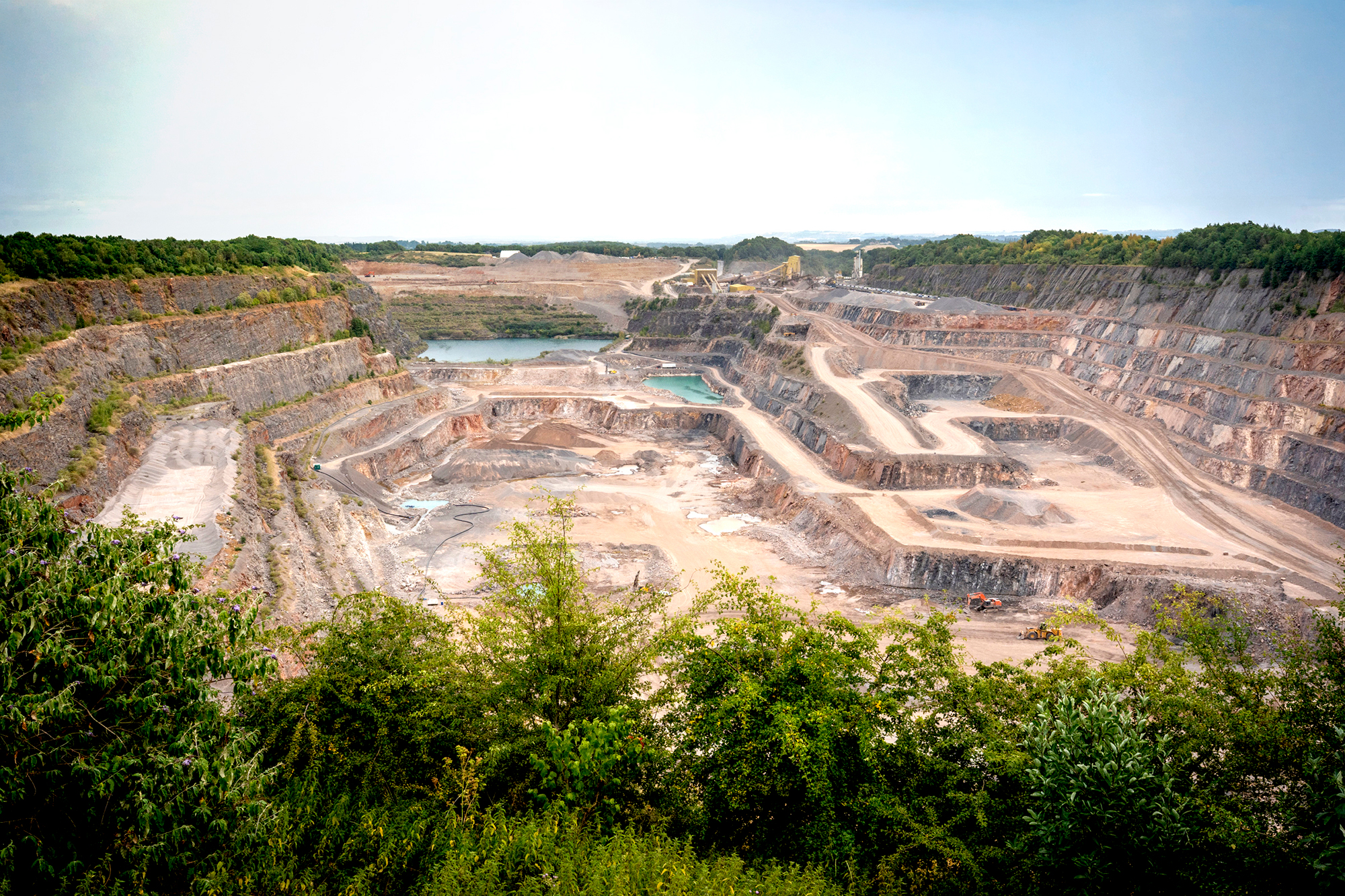

Whatley quarry has been supplying vital building materials for use in the construction and maintenance of homes, schools, hospitals and roads for nearly 100 years.
To make the most of its existing reserves, we are seeking permission to extend extraction within Whatley’s existing quarry boundary as well as the timeframe for quarrying.
Activity would be limited to within the existing site boundary so, beyond the quarry gate, it would be business as usual and our neighbours would see little change.
We are not proposing any changes to the quarry’s permitted operating hours or blasting approach. This new application also remains in line with our commitment that combined aggregate volumes from our Whatley and Westdown sites will not exceed the current permitted levels for Whatley alone.
Changing the end date for Whatley would secure the long-term future of the quarry and make the best use of all available reserves.
Whatley will continue to focus on supplying national demand by rail, helping keep HGVs away from local villages and minimising carbon emissions while also sustaining local jobs and securing supplies for local and national customers.
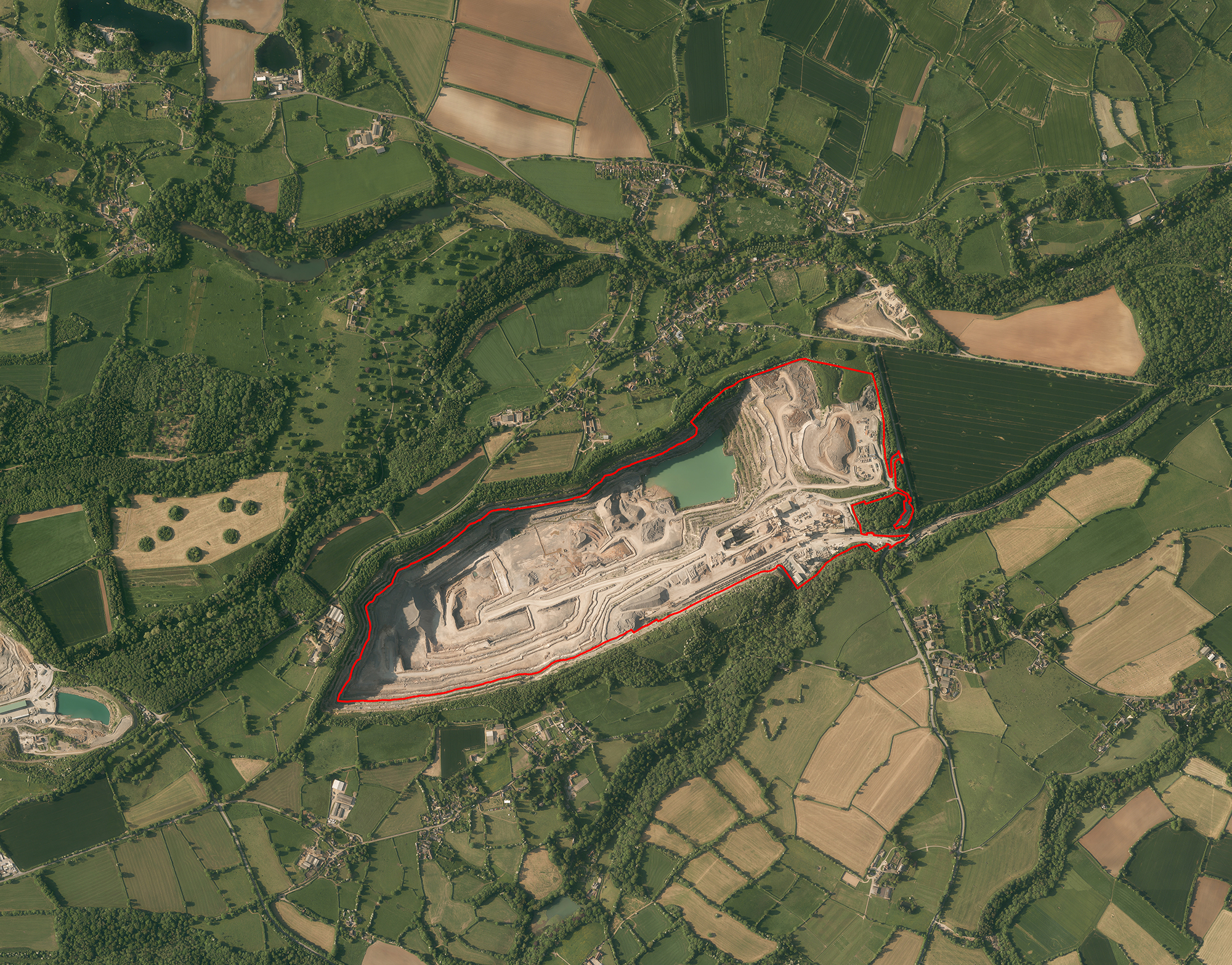
Our proposals
Our plans aim to ensure the best use of Whatley’s reserves and include:
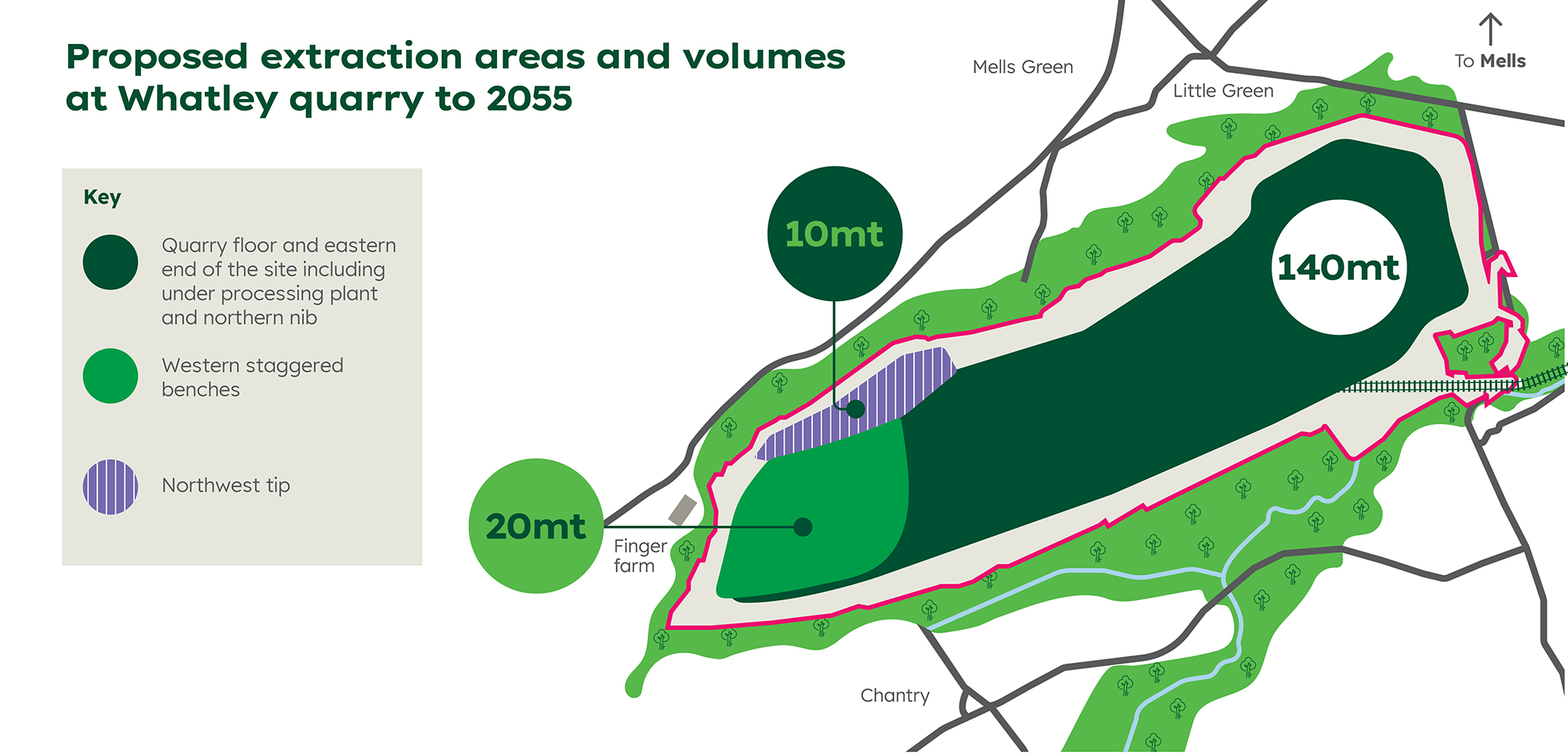
- Continued extraction of permitted but constrained reserves within the western staggered benches, eastern part of the quarry and beneath site plant to the previously approved 0m AOD level (sea level).
- Additional extraction within the existing consented areas of the quarry by reprofiling the western staggered benches and northwest tip.
- Deepening the western staggered benches, existing quarry floor and eastern end of the site by the equivalent of four additional benches to -60m AOD.
- Extending the quarry’s end date to 2055 to allow both existing and additional limestone reserves to be secured.
If approved, our scheme would allow us to make the best use of around 170 million tonnes of reserves. This includes 80 million tonnes (mt) of already consented reserves, which are becoming increasingly difficult to access, as well as 90mt of additional reserves.
Environment and restoration
An independent Environmental Impact Assessment (EIA), covering a wide range of topics, will accompany our application. It has been carried out to identify any potential impacts of our proposals and how they can be mitigated.
Whatley quarry is already well screened and the proposed extension areas would not be visible from outside of the site.
Updated restoration plans would still see the excavated void filled with water to create a deep lake as well as the creation of a mosaic of habitats such as woodland, scrub, grassland and wetland suitable for dormice, bats, otters, wildfowl and invertebrates.
Help shape our plans
Our pre-application consultation will run for four weeks from 00:01 Thursday 01 October until 23:59 Saturday 31 October 2026.
During this period we are holding three public drop-in events where members of our team and specialist consultants will be on hand to answer your questions. Please join us on:
Tuesday 06 October 2026 between 15:00 and 20:30 at:
The Church of the Holy Trinity, Chantry BA11 3LJ
Thursday 08 October 2026 between 15:00 and 20:30 at:
Nunney Village Hall, Berry Hill, Nunney BA11 4NR
Thursday 15 October 2026 between 15:00 and 20:30 at:
Mells Tithe Barn, Selwood Road, Mells BA11 3PN
We are also holding an online event on Tuesday 20 October 2026 between 19:00 and 20:00. To register to attend, please complete the form alongside.
To register to attend our online pre-application event on Tuesday 20 October 2026 between 19:00 and 20:00, please supply the following information:
An email will be sent to the email address provided by 19 October with a link to the online event, which is being held via Microsoft Teams.
Whatley proposals FAQs
Our extensive FAQ section is available below.
Why do you need to expand extraction at Whatley quarry?
Whatley quarry has been supplying vital building materials for use in the construction and maintenance of homes, schools, hospitals and roads for nearly 100 years. However, permitted reserves of limestone deposits within the quarry are becoming increasingly constrained, threatening security of supply.
Extending Whatley would secure much-needed supplies of limestone by providing access to around 80 million tonnes (mt) of already consented reserves as well as around 90mt of additional reserves. Extending the quarry’s end date to 2055 would allow for all 170mt of identified mineral reserves to be quarried in the most effective way, while also mitigating impact on our near neighbours.
All activity would be within the existing site boundary and there are no amendments to our permitted operating hours or blasting, so outside the quarry gates it would be business as usual.
If approved, our proposals would help to maintain steady supplies of limestone as well as securing more than 60 jobs on site and up to 200+ in the local supply chain.
Why do we need more limestone?
Limestone is an essential aggregate used in building materials to construct and maintain our homes, hospitals, schools, and roads, as well as the infrastructure needed to support the UK’s net zero ambitions.
The UK uses around 250 million tonnes of aggregate a year. For example, building an average house needs 200 tonnes of aggregate and 12 tonnes of mortar. A floating offshore wind turbine uses 15,000 tonnes of concrete and, the Lower Thames Crossing has used 8.8 million tonnes of aggregate, concrete and asphalt.
This means that we use the equivalent of 4 tonnes of aggregate for every man, woman and child, every year in the UK. But, while many may assume that permitted reserves of aggregate are plentiful, that is just not the case. The latest figures from the Mineral Products Association (MPA), show that annual sales of crushed rock continue to far exceed the replenishment rate of new quarry permissions. In fact, between 2014 and 2023 only 32 per cent of crushed rock quarried was replaced by new permissions. And, of course, quarries can only exist where the reserves naturally occur.

We ensure the most efficient use of resources through high levels of material reuse and recycling but primary material, including limestone, is still needed to ensure building materials’ strength, integrity and durability in a wide range of applications.
What do your proposals include?
Our proposals would maintain quarry operations at Whatley to 2055 by making the best use of already consented limestone reserves, which are becoming increasingly difficult to access, as well as additional reserves.
Quarry activity would include:
- Continued mineral extraction to sea level (0m AOD) of permitted but constrained reserves, including at the western part of the quarry and under the processing plant.
- Releasing additional reserves to 0m AOD within the existing quarry boundary by changing the profile of the western staggered benches and the northwest tip, as well as extending quarrying in the eastern end of the site to this level.
- Deepening the existing quarry floor as well as the western staggered benches, northern tip and the eastern end of the site by the equivalent of four additional quarry benches to -60m AOD.
- Extending the quarry’s end date to 2055 to allow enough time for both existing and additional limestone reserves to be extracted.
All activity would be within the existing site boundary and there are no amendments to our permitted operating hours or blasting, so outside the quarry gates it would be business as usual.
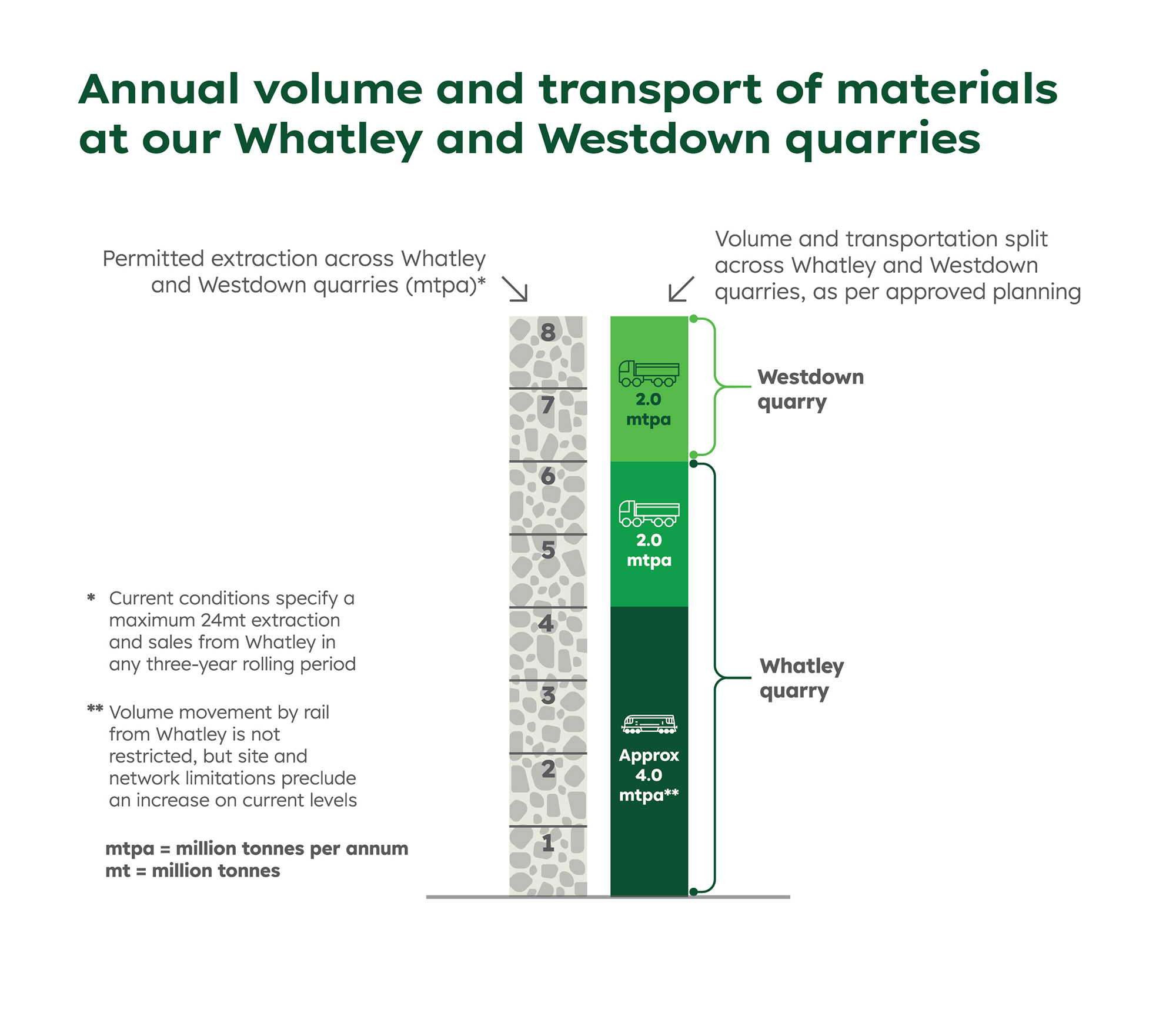
Whatley is currently permitted to extract up to 24 million tonnes of aggregate in any three-year period; an average of 8mt a year (mtpa). Our approved plans to reopen Westdown quarry included a commitment to keep combined volumes from both sites at this level and this remains unchanged.
Combined aggregate volumes across both quarries would remain the same as the current permitted levels for Whatley alone.
How do you plan to extract the additional material at Whatley?
Our proposals are based on extracting all identified mineral reserves in the most efficient way, while also minimising impact on the environment and our near neighbours.
Planned extraction would take place in five phases:
- In phases 1 and 2 quarrying would take place in the central and eastern parts of the quarry, first to the already-permitted level of 0m AOD, before deepening to -60m AOD.
- Phase 3 would see extraction move to the western staggered benches and the northern tip, deepening to -60m AOD.
- In phases 4 and 5, the area beneath the processing plant would be quarried, first to the already permitted level of 0m AOD and subsequently to -60m AOD.
- These final phases would see the fixed processing plant removed and a switch to mobile crushing. And, as the rail head would no longer be available to transport material by rail, output would reduce to around 2 million tonnes a year, to be transported by road.
Extending Whatley’s end date will mean that all identified limestone reserves can be extracted in the most efficient way, while also minimising impact on the environment and our near neighbours.
Will the railhead remain throughout the quarry’s extended life?
Towards the later phases of extraction, the rail head would be removed in order to access the limestone reserves underneath.
This material – to 0m AOD (sea level) – is already included in our existing permissions and it has always been our intention to access this area of the quarry in the later stages so that the rail head can be kept in situ as long as possible.
Along with the rail head, the fixed processing plant would also be removed. As a result, output would be reduced to around 2 million tonnes a year so, even without the rail head, there would be no more HGVs on the roads.
Why do you need new permissions to extract limestone from within the existing quarry?
To extract the already-permitted reserves at Whatley we need to extend the quarry’s permitted life. We have also identified additional reserves within the current boundary that are not included within our existing planning permissions. Both the time extension and permission to access additional reserves require us to apply to the Mineral Planning Authority, in our case Somerset Council (SC), to vary the existing consents.
Our proposals would maintain quarry operations to 2055 by making the best use of already consented limestone reserves, which are becoming increasingly difficult to access, as well as additional reserves.
We first submitted proposals to SC (then Somerset County Council (SCC)) in 2011 as part of the Review of Mineral Planning (ROMP) process. Despite our best efforts, the application has yet to be determined. In 2020, SCC asked us to update the environmental information supporting the ROMP, because the original surveys and studies were out of date. In response, our 2022 (revised) Scoping Report proposed a single planning application, supported by an Environmental Impact Assessment (EIA) covering both the outstanding ROMP and our proposals to deepen and extend the life of Whatley quarry.
As we look to secure Whatley’s long-term future – and recognising that mineral planning applications can take several years to determine – we have decided to bring our proposals forward. It’s important to us to be transparent about our activities, keeping the local community informed and seeking views before submitting our application.
Why does the limestone have to come from Whatley quarry?
It’s all about geology. Quarries can only exist where the hard rock reserves naturally occur.
Extracting limestone from Whatley quarry goes back nearly 100 years and it has been rail-connected since the 1930s.
The site has previously been recognised by Somerset Council (SC) as a strategic aggregate quarry in its adopted Minerals Local Plan. Today, Whatley supplies around 6 million tonnes (mt) of aggregate per year for use in making ready-mixed and precast concrete products, as well as asphalt for use in road construction and maintenance.
Around 4mt a year is transported by rail, with the quarry supplying material to London and the south east of England, where there are no natural deposits of limestone. Transporting a tonne of material by rail, instead of road, cuts the associated CO2 emissions by around two thirds, as well as helping to cut traffic by keeping lorries off the road.
Why is an extension needed at Whatley as well as other planned quarry extensions in the east Mendips?
We can’t comment on our competitors’ business strategies but our approach in the east Mendips is based on securing consistent supplies of aggregate for use both locally and nationally, where it is often used in the construction of major infrastructure projects.
Combined aggregate volumes across both Whatley and Westdown quarries would remain the same as the current permitted levels for Whatley alone with no increase in HGVs levels. Westdown, located close to local freight routes, will focus on supplying local markets, helping to keep HGVs away from local villages, with Whatley continuing to focus on supplying national demand by rail.
If approved, these proposals would secure Whatley’s future for the next three decades, allowing us to continue the significant contribution we make to the economy, as well as retaining over 60 on site jobs, plus many more in the supply chain.
How does quarrying fit with a low carbon agenda?
Minerals play a vital role in the construction of the infrastructure needed to support the country’s switch to a low carbon economy. Plus, aggregates are also still needed to maintain existing building and infrastructure.
We’re committed to achieving net zero across our business by 2050 and we’re making good progress. We ensure the most efficient use of resources through high levels of materials’ reuse and recycling as part of our commitment to growing the circular economy. But primary material, including limestone, is still needed to ensure building materials’ strength, integrity and durability in a wide range of applications.
Will extracting minerals at below sea-level be safe?
There are many examples of hard rock quarries both in the UK and elsewhere with permissions to extract material below 0m AOD (sea level).
Quarrying techniques have advanced significantly since Whatley quarry’s existing planning permissions were granted in the 1990s. These allowed extraction to 0m AOD (sea level) but may quarries now extract minerals from far below this level. For example, our own Tytherington quarry, in South Gloucestershire recently secured permission to extract to -40m AOD.
Whatley quarry currently has 10 operational benches and our proposals to deepen sections of the quarry would see an additional four benches developed. Independent studies commissioned by Heidelberg Materials highlight that this can be done at Whatley without impacting the local environment or any groundwater systems. These detailed hydrological and hydrogeological reports have also shown that regional water systems are not connected, so going deeper at Whatley will not impact water supplies to the wider area.
What studies have you carried out to ensure that extracting deeper at Whatley won’t impact on groundwater?
The independent Environmental Impact Assessment (EIA) that will accompany our planning application has examined the water environment at Whatley quarry in detail.
The hydrological and hydrogeological reports have also shown that regional water systems are not connected, so going deeper at Whatley will not impact water supplies to the wider area. We have shared the findings of our East Mendips groundwater modelling with the Environment Agency (EA). Our understanding is that the EA is going to continue and update this work, with the support of all quarry operators within the Mendip Quarry Producers (MQP) group, including Heidelberg Materials. This will provide quarry operators with enhanced information to support future decision making.
What impact will blasting deeper have?
The UK has very strict regulations, and modern blasting and drilling techniques are designed to minimise vibration and air over pressure so that nearby homes and buildings are protected from structural damage.
In recent years the Whatley team has worked closely with our blasting specialists to reduce blast vibration. This sees us, wherever possible, designing blasts to have a vibration level of 4.5mm/s Peak Particle Velocity (PPV) compared to the regulatory limit of 9mm/s PPV on this logarithmic scale. The average blast PPV so far this year at Whatley has been 2.73mm/s – so well below the regulatory limit. Going forward, wherever possible, this voluntary commitment will remain in place and all blasts will be within the regulatory limit.
Quarries across the UK and around the world extract aggregate at levels below 0m AOD (sea level), including to -60m AOD and more. Specialist modelling indicates that excavating at deeper levels at Whatley will not impact on how blasts are experienced by our near neighbours.
Will both Whatley and Westdown operating mean more HGVs on the roads?
Our proposals are based on the commitment that the combined aggregate volumes across both Whatley and Westdown quarries would remain the same as the current permitted levels for Whatley alone. Westdown, located close to local freight routes, will focus on supplying local markets, helping to keep HGVs away from local villages, with Whatley continuing to focus on supplying national demand by rail. This means there will be no increase in HGVs over current permitted levels.
However, it is possible that there could be a marginal increase in the number of HGVs on recent levels as, in the last few years, we have not been transporting the full, permitted volumes by road from Whatley quarry. However, with Westdown located within easy access of the county’s freight routes, we believe that any impact will be negligible and neighbouring villages will actually see a reduction in HGV traffic.
At present, our permits for Whatley allow for a maximum of 24 million tonnes of extraction and sales in any three-year rolling period. This equates to around eight million tonnes per annum (mtpa), of which half (four mpta) can be transported by road, with the rest going by rail. In recent years the volume of HGV traffic has been below the permitted level as Whatley has sought to maximise capacity at the railhead.
Looking ahead it is expected that, with both quarries fully operating, two mtpa would be transported by road from Westdown; two mtpa by road from Whatley and the remainder by rail from Whatley. This will lead to a reduction in HGV traffic on some routes and we believe that the resumption of mineral development at Westdown quarry and our proposals for Whatley will have no significant traffic effects.
What benefits do these proposals have for local people?
We all depend on steady supplies of vital construction materials to build and maintain the infrastructure we rely on – from fixing potholes and building new homes, schools and hospital to maintaining bridges and power supplies. Scarcity of supply would drive up prices and even lead to materials being imported, resulting in a loss of jobs, increased carbon emissions and more lorries on the road.
At a local level we employ more than 60 people on site and many more in the supply chain as well as providing apprenticeship and other career opportunities. In addition, we also make a make significant contribution to local services through business rates and other taxes and, overall, our contribution to the local and national economy, is estimated to be worth more than £75 million per year (Gross Value Added).
We are committed to being a good neighbour and playing a positive part in the local community, as well as protecting and enhancing the natural environment.
We provide support for a wide range of community initiatives through the donation of time, money and materials. Recent examples include Nunney First School playground, Great Elm Village Hall, Mells Sports and Recreation Ground, Colford allotments and Frome's Mary Bailey Playing Field.
In addition, we have hosted many school visits, created a loop walk around Whatley quarry, carried out extensive repairs to the footpaths at Egford Brook and boosted biodiversity across our landholding, including at Asham Wood SSSI, by careful land management.
As part of the community for the next three decades, we recognise that we have a responsibility to support the priorities and aspirations of local people. We will continue to work closely with our liaison group and other key stakeholders to ensure the more positive benefits of quarrying to the local community are fully realised.
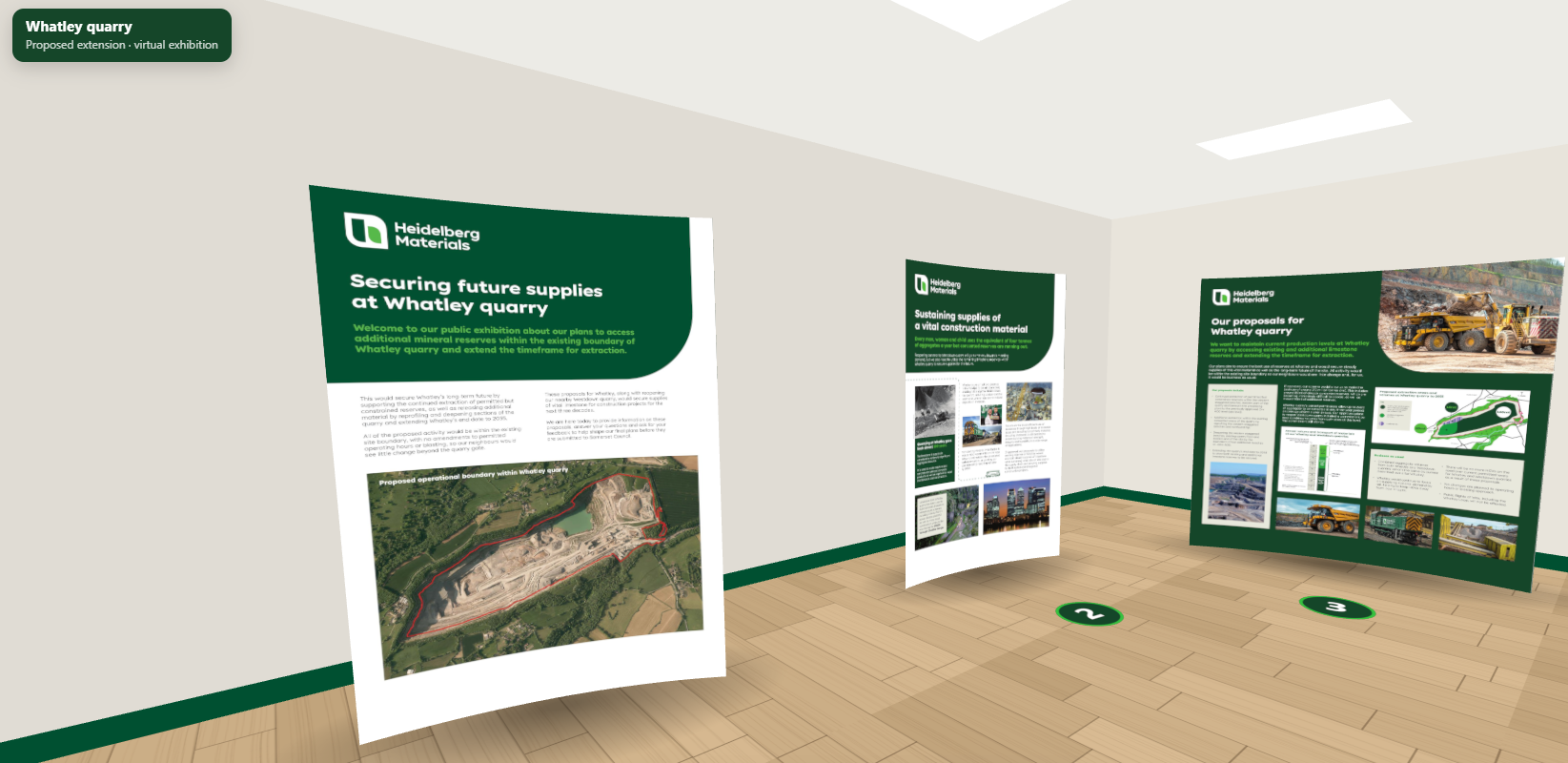
Virtual exhibition
For further information, please view our virtual exhibition where you will find our exhibition panels highlighting the different aspects of our proposals. These will be on display at our in person events and can also be viewed and downloaded here.
Next steps
We will review the feedback we receive on our current plans from local people and other stakeholders, and use this to help inform our final proposals.
We will then submit our planning application to Somerset Council (SC), which will consult with statutory bodies and invite comments from residents before making its decision.
If approved, our proposals would secure the future of Whatley quarry for the next three decades.
Having your say
Your feedback is important to us and will help shape our final plans. You can provide this at one of the in-person events, via the form below or email us at whatley.quarry@uk.heidelbergmaterials.com
The deadline for responses is 23:59 on 31 October 2026.